Introduction: The New Search Landscape
Search has changed. A decade ago, ranking on the first page of Google was the ultimate goal. Today, users expect instant, precise answers — often without clicking any link at all. Voice assistants field millions of queries daily. AI-powered search engines like Google’s Search Generative Experience (SGE) and Perplexity synthesize information and present it directly in the results page.
This shift has given rise to Answer Engine Optimization (AEO) — a strategic discipline focused on positioning your content as the definitive answer that search engines and AI tools surface in response to a user’s question. When combined with traditional Search Engine Optimization (SEO), AEO creates a powerful, complementary approach that improves visibility across every layer of modern search.
In this article, we’ll explore what AEO is, how it differs from SEO, and how to integrate the two for maximum search visibility results.
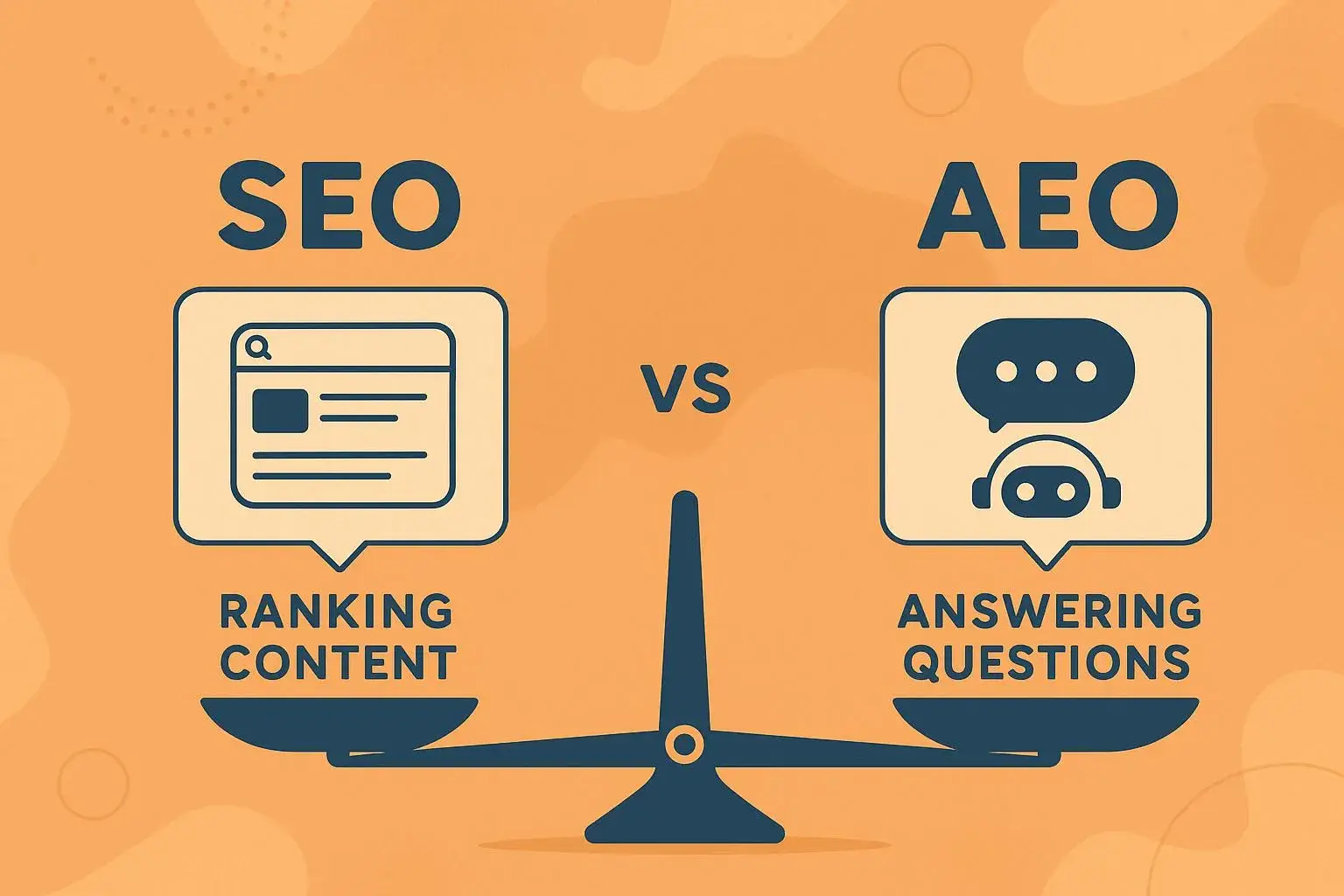
What Is AEO (Answer Engine Optimization)?
AEO is the practice of structuring and optimizing content specifically so that it gets selected as a direct answer by search engines, voice assistants, and AI answer engines. When Google displays a featured snippet, when Siri reads a result aloud, or when a ChatGPT-powered search tool cites a source — that’s AEO at work.
The core premise of AEO is simple: match the format and specificity that answer engines expect. This means writing concise, authoritative responses to clearly defined questions, using structured data markup, and building content around the natural language queries that real users ask.
What is the difference between SEO and AEO?
SEO and AEO are not competitors; in fact, SEO and AEO complement each other. But understanding their distinct focus areas is essential before integrating them.
Traditional SEO focuses on ranking signals: domain authority, backlink profiles, page speed, keyword density, and on-page technical factors. The goal is to earn a position in organic search results so users will click through to your website.
AEO, by contrast, aim on answer quality and answer format. It asks: “If a search engine or AI system needed to answer this question right now, would it choose my content?” The goal is to be the source that gets cited, quoted, or read aloud — whether or not the user ever visits your site.
| Dimension | SEO | AEO |
|---|
| Primary Goal | Organic rankings and click-throughs | Featured snippets, voice answers, AI citations |
| Content Focus | Keywords and topics | Questions and direct answers |
| Optimization Target | Search engine algorithms | Answer engines and AI models |
| Success Metric | SERP position and CTR | Snippet ownership, zero-click visibility |
| Structured Data | Helpful but optional | Essential |
Why Integrating SEO with AEO Is Important in 2026?
Search behavior is fragmenting. Users search via traditional Google, voice queries on smart devices, AI chat interfaces, and zero-click experiences on social platforms. A strategy that focuses on only one of these channels leaves significant visibility on the table.
Integrating SEO with AEO addresses this fragmentation head-on. A well-optimized page that also answers questions directly can simultaneously rank in the organic blue links, appear in a featured snippet, get read by a voice assistant, and be cited by an AI answer engine — all from the same piece of content. That kind of multi-channel presence is one of the most powerful competitive advantages available in digital marketing today.
Moreover, Google’s algorithm updates continue to reward content that demonstrates Expertise, Experience, Authoritativeness, and Trustworthiness (E-E-A-T). These same qualities that make content rank well in SEO also make it more likely to be selected as an authoritative answer in AEO contexts.
Best Strategies for Integrating SEO with AEO
Build Content Around Questions, Not Just Keywords
SEO traditionally starts with keyword research. AEO integration means taking that research one step further: identifying the specific questions those keywords represent. Use tools like Google’s “People Also Ask” boxes, AnswerThePublic, and Semrush’s keyword intent filters to map out the questions your target audience is genuinely asking.
For each piece of content, identify a primary question and give it a clear, direct answer within the first 100–150 words of the relevant section. This satisfies both search engine ranking signals (through keyword relevance) and answer engine requirements (through question-answer formatting).
Use Structured Data Markup Extensively
structured data — particularly Schema.org markup — is the bridge between SEO and AEO. It tells search engines exactly what type of content a page contains and how to interpret it.
For AEO integration, prioritize the following schema types:
FAQ Page schema marks up question-and-answer content so Google can display it directly in search results as expandable FAQ entries. HowTo schema structures step-by-step processes, making them eligible for rich result displays. Speakable schema explicitly signals to voice search systems which sections of your page are suitable for audio delivery. Article and News Article schema helps AI systems understand authorship, publication date, and topical authority.
Implementing these schema types doesn’t just help with AEO — it enriches your organic SERP presence with rich snippets that can significantly improve click-through rates, benefiting your SEO performance as well.
Optimize for Featured Snippets Deliberately
Featured snippets are the most visible bridge between SEO and AEO. They appear at position zero — above organic results — and are the format that voice assistants and many AI engines use as their primary answer source.
To win featured snippets, structure your content to mirror the three snippet formats Google displays most frequently. Paragraph snippets work best for “what is” and “why” questions — write a tight 40–60 word answer immediately after a clearly worded H2 or H3 question heading. List snippets are ideal for “how to” and “best of” queries — use numbered or bulleted lists with concise, scannable items. Table snippets suit comparative and data-rich content — use clean HTML tables with clear column headers.
The key principle is that optimizing for featured snippets through SEO best practices simultaneously positions your content for AEO selection.
Build Topical Authority Through Content Clusters
Both SEO and AEO reward depth over breadth. A site that comprehensively covers a topic — through a network of interlinked content covering every angle, question, and subtopic — is both more likely to rank well organically and more likely to be recognized by AI systems as an authoritative source.
The content cluster model is the structural solution: a comprehensive pillar page addressing the broad topic, supported by cluster pages diving deep into specific subtopics and questions. This architecture sends strong topical authority signals to search algorithms while creating the rich, multi-angle answer landscape that AEO systems draw from.
Prioritize E-E-A-T Signals Across All Content
Experience, Expertise, Authoritativeness, and Trustworthiness signals matter for both SEO rankings and AEO selection. AI answer engines are increasingly cautious about surfacing content from sources that lack credibility markers.
Strengthen your E-E-A-T by including clear author bios with credentials and professional background on every article. Cite reputable external sources and link to them. Keep content updated — stale information signals lower trustworthiness. Earn backlinks and mentions from authoritative sites in your industry. Use first-person experiential language where relevant, as Google and AI systems increasingly value evidence of real-world experience.
Optimize Technical SEO as the Foundation
AEO cannot function without a strong technical SEO underpinning it. If search engines cannot efficiently crawl, index, and understand your content, no amount of answer-focused writing will get your content selected.
Ensure fast page load speeds — Core Web Vitals directly impact both ranking and snippet eligibility. Use clean, semantic HTML so crawlers and AI parsers can accurately interpret your content hierarchy. Create and submit XML sitemaps. Implement HTTPS. Use canonical tags correctly to prevent duplicate content issues. Make sure your site is fully mobile-optimized, since voice search is predominantly mobile.
Measuring the Success of Your Integrated SEO + AEO Strategy
Tracking the performance of an integrated strategy requires metrics from both disciplines.
For SEO performance, monitor organic traffic, keyword rankings, domain authority growth, backlink acquisition, and click-through rates from organic search.
For AEO performance, track featured snippet ownership (using tools like Semrush or Ahrefs’ SERP feature tracking), voice search visibility (survey-based or estimated from featured snippet performance for question queries), AI citation frequency (where tools permit), and zero-click impression share through Google Search Console’s impression data.
The most revealing metric for an integrated strategy is the combination of impressions and engagement: high impressions with lower click-throughs may indicate strong AEO performance (your answer is being delivered directly), while high click-throughs indicate strong SEO performance. Both outcomes create brand visibility and authority.
Common Mistakes to Avoid
Treating AEO as a separate content silo. The most effective approach integrates answer-focused formatting into your existing SEO content production workflow — not as a parallel effort.
Ignoring mobile and voice UX. If your site is difficult to navigate on mobile or your content doesn’t read naturally when spoken aloud, your AEO efforts will underperform regardless of your content quality.
Over-optimizing for snippets at the expense of depth. Featured snippets reward conciseness, but AI answer engines reward depth and authority. Strike a balance: lead with a crisp direct answer, then support it with detailed, substantive content.
Neglecting schema implementation. Structured data is non-negotiable for AEO. Skipping it means competing with hands tied behind your back.
Conclusion: The Future Belongs to Integrated Search Strategies
The distinction between “ranking” and “answering” is dissolving. As AI becomes the interface through which users interact with information — through voice, chat, and AI-enhanced search — the brands that win will be those whose content is both technically optimized for search engines and strategically formatted for answer engines.
Integrating SEO with AEO is not a trend to watch — it’s a strategic imperative for any brand serious about long-term search visibility. Start by auditing your existing content for question-answer opportunities, implement structured data across your highest-value pages, and build topical authority through comprehensive content clusters.
The search landscape will keep evolving. An integrated SEO + AEO strategy ensures your content evolves with it.